Boulder
The Door into SummerBoulder is both a center of experimental physics and a place where Dan Davis must negotiate the practical demands of his plans. Its university laboratories connect Dr. Hubert Twitchell’s earlier gravitational research to the time-displacement experiment, while its Colorado setting becomes the focus of a later dispute about relocating a business to California.
University and Laboratory Setting
During Chuck Freudenberg’s senior year at the University of Colorado Boulder, he earned extra money as a laboratory assistant, first in the university’s cryogenics laboratory. A defense contract concerning Edinburgh field theory led the school to build a large new physics laboratory in the mountains outside town. Chuck was reassigned there to work under Dr. Hubert Twitchell, a professor whose scientific reputation had been overshadowed by his failure to receive the Nobel Prize.
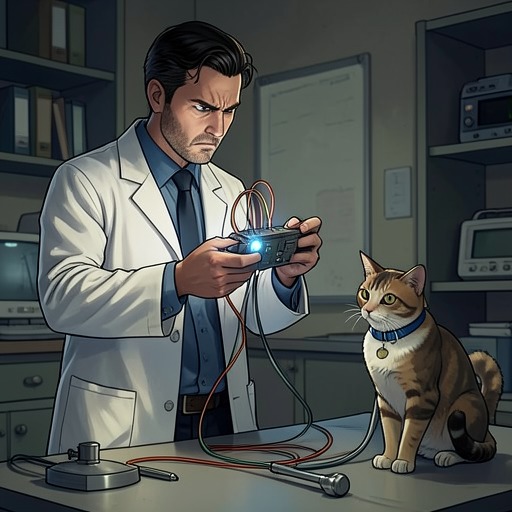
Twitchell’s experiments at the mountain laboratory gave Boulder a decisive place in the novel’s technological history. He tried polarizing a field around a different axis in the hope of reversing gravity rather than merely leveling it. After feeding the results into a computer, he tested the effect on two marked silver dollars in a cage; when he activated the solenoid, the coins disappeared. The episode establishes the experimental basis for the field manipulation that later makes time displacement possible.
Twitchell’s Return to the Laboratory
When Dan Davis sought Twitchell’s help, the scientist was still living in Boulder, though retired as professor emeritus and spending much of his waking time in the faculty-club bar. The club was closed to outsiders, so Dan spent four days trying to find him elsewhere before meeting him in another bar and buying him a drink. Twitchell’s decline contrasts with the scale of his earlier scientific promise: he remains brilliant, but disappointment, age, and alcohol have diminished the life around that intellect.
The return to the laboratory turns that history into immediate action. When the experiment required full power, Twitchell called the university powerhouse’s night superintendent and demanded emergency power across the bus bars of the Thornton Memorial Laboratory within eight minutes. He then worked at the control board; the meters swung across their dials and a red light came on. The sequence shows that Twitchell’s authority is not merely intellectual: he can still command the institutional resources needed to put the experiment into operation.
Colorado and the California Dispute
Boulder also represents the Colorado life that John Sutton is reluctant to leave. When Dan made clear that John would have to run the business while Dan pursued other work, John agreed but insisted that working conditions mattered. He argued that no sensible Colorado resident would move to California, invoking the state’s winters, changing seasons, brisk mountain air, and scenery; Jenny Sutton, a native Californian, complicated his claim by allowing that she would not rule out returning.
Dan’s insistence that the move was necessary makes Boulder part of a practical conflict rather than a simple celebration of place. The contrast between Colorado and California sets personal preference against the demands of the plan, while John and Jenny’s different responses prevent the dispute from resolving into a single shared attitude. Boulder thus links scientific work, institutional power, and the human costs of organizing a future elsewhere.